




USTR’s July 23 action imposes tariffs on imports from 60 trading partners to press them to strengthen controls on forced-labor imports. Depending on the product, the new duty may be zero, a partial top-up, or a full 10% or 12.5%.
On July 23, 2026, the Office of the United States Trade Representative (“USTR”) imposed new Section 301 tariffs on imports from 60 trading partners. Effective at 12:01 a.m. Eastern time on July 24, 2026, most nonexempt goods are subject to an additional duty of 10% or 12.5%, with a different calculation for products from the European Union, Taiwan, Japan, South Korea, and Switzerland. According to USTR, the covered trading partners account for approximately 99.4% of U.S. imports. The action therefore reaches nearly every major U.S. supply chain, including companies that do not import directly but rely on imported materials, components, or finished goods.
USTR based the tariffs on findings that the 60 trading partners had failed to prohibit or effectively police imports made with forced labor. The timing is also significant. The duties took effect as the Administration’s temporary 10% Section 122 surcharge reached its 150-day limit, replacing that surcharge for many goods with new duties imposed under a statute that expressly authorizes action against foreign government practices.
The tariffs will not affect every import in the same way. An EU product may receive only a partial top-up. A qualifying Canadian or Mexican product may enter free of the new duty under USMCA. A product already subject to Section 301 may face another layer of duties. Those differences can materially change landed cost, pricing, and margins.
How the New Tariffs Work
The table below shows the four rate structures. Fifty-five trading partners face a flat additional duty of either 10% or 12.5%. The European Union, Taiwan, Japan, South Korea, and Switzerland receive “top-up” treatment. For those five, the new duty fills the gap between the product’s applicable column 1 tariff rate—generally the ordinary U.S. tariff rate listed in the Harmonized Tariff Schedule—or its ad valorem equivalent and the applicable 10% or 12.5% threshold.
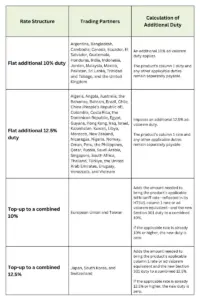
The groupings in the table follow the White House memorandum directing the final action and CBP’s implementation guidance. The table covers only the duty imposed through the July 23 action. Ordinary customs duties, earlier Section 301 duties, antidumping and countervailing duties, other Chapter 99 duties, and customs fees remain separate.
The flat-rate and top-up categories operate differently.
The flat rates are imposed in full, regardless of the product’s existing tariff rate. A covered Indian product receives the additional 10% even if its column 1 rate is already 8%. A covered Vietnamese product receives the additional 12.5% on top of its column 1 rate.
The five top-up trading partners receive only the amount needed to reach the applicable threshold. However, the top-up does not cap the importer’s total duty burden at 10% or 12.5%. It covers only the combination of the applicable column 1 rate and this particular new Section 301 duty. Earlier Section 301 tariffs, antidumping or countervailing duties, and other applicable charges remain separately payable.
Example – One Product, Three Different Results
Consider a $10,000 shipment of low-voltage control switches used to operate conveyor equipment at a bottling plant. To isolate the effect of the new rate categories, assume that the switches are nonexempt, properly classified, and subject to an applicable column 1 ad valorem rate of 6.5%.
If the switches originate in an EU member state, the new duty tops up the 6.5% ordinary rate by 3.5%. The importer would pay $650 in ordinary duties and $350 under the new Section 301 action, for a combined rate of 10% and a total of $1,000.
If the same switches originate in India, the full 10% Section 301 duty is added to the 6.5% ordinary rate. The combined rate is 16.5%, or $1,650 on the $10,000 shipment.
If the switches originate in Vietnam, the full 12.5% Section 301 duty is added to the 6.5% ordinary rate. The combined rate is 19%, or $1,900.
The product, customs value, and ordinary tariff rate are identical in each example. Country of origin changes the combined ordinary and new Section 301 duties by as much as $900. Any other Section 301 duties, antidumping or countervailing duties, taxes, or fees would be added to those amounts.
Exemptions and Trade Preferences
The rate assigned to the relevant trading partner is only the starting point. USTR exempted hundreds of products, created additional exemptions for specified goods from certain trading partners, excluded merchandise already covered by designated Section 232 measures, and preserved relief for qualifying imports under USMCA and CAFTA-DR. Whether any of those provisions applies depends on the product’s classification, country of origin, and treatment at entry.
Product-Level Exemptions
When USTR proposed the tariffs in June 2026, it also proposed an initial list of exempt products aimed at avoiding domestic shortages, broader economic disruption, and tariffs on goods unavailable from adequate U.S. or alternative sources. After receiving more than 1,600 comments and holding a three-day hearing, USTR retained most of that list, narrowed certain chemical exemptions to specified pharmaceutical uses, and added another 471 products in its prepublication final notice.
The additions illustrate the practical concerns USTR considered. Certain fertilizer and pesticide inputs were exempted where limited alternative sources could create shortages and increase costs for U.S. manufacturers. Unflavored instant coffee made the list because domestic production and sources outside the covered trading partners could not meet U.S. demand. For specialized semiconductor-manufacturing equipment, USTR pointed to the difficulty of finding substitutes and the equipment’s importance to expanding domestic chip production.
USTR also adopted origin-specific exemptions for selected trading partners. For example, an additional list applicable only to U.K.-origin goods includes medical or surgical sterilizers classified under HTSUS 8419.20.0010. A qualifying U.K.-origin sterilizer is therefore exempt, while the same classified product from India or Vietnam is not (unless another exemption applies).
Products Already Covered by Certain Section 232 Measures
Section 232 is a separate trade authority used to impose tariffs or other import restrictions on designated products based on national-security findings. Merchandise covered by the particular Section 232 provisions identified in USTR’s notice—including specified steel, aluminum, copper, vehicle, wood-product, heavy-vehicle, and semiconductor articles—generally keeps that treatment without also receiving this new Section 301 duty. To qualify, the imported article itself must fall within a listed Section 232 Chapter 99 provision. A machine does not qualify merely because it contains steel, and a component does not qualify merely because it will be installed in a vehicle.
USMCA and Textile Preferences
USMCA remains in force, although the United States did not agree at the July 1 joint review to confirm the agreement’s continuation. Under Article 34.7, the parties may still confirm at subsequent annual reviews; absent any future confirmation, USMCA would terminate on July 1, 2036. The unresolved review creates uncertainty for longer-term planning but does not suspend current benefits.
Qualifying Canadian and Mexican goods therefore remain exempt from the new Section 301 duty, but eligibility requires more than purchasing from a Canadian or Mexican supplier or shipping through either country. The product must satisfy the applicable USMCA rule of origin, and the preference must be claimed at entry.
Certain textile and apparel goods from Costa Rica, the Dominican Republic, El Salvador, Guatemala, Honduras, and Nicaragua are also exempt when entered free under the Dominican Republic-Central America-United States Free Trade Agreement, or CAFTA-DR. USTR also plans tariff-rate quotas for specified textile and apparel imports from Bangladesh, Cambodia, Indonesia, and Malaysia based on their importation of U.S. cotton and textile inputs. Those quotas are not yet operative.
No Current Exclusion-Request Process
The published exemption lists are the only product-specific exclusions currently available, and companies cannot currently ask USTR to add another product to the exemption lists. USTR considered creating an exclusion process but declined to do so. And, although Section 307 permits USTR to modify the actions covering individual trading partners later, there is no current application procedure for an importer seeking an individual waiver.
Shipments Subject to the New Duties
For most shipments, the controlling event is customs entry. The new duties apply to covered goods entered for consumption, or withdrawn from a bonded warehouse for consumption, at or after 12:01 a.m. Eastern time on July 24. That means a container can arrive before July 24 and still owe the duty if the goods are entered on or after that date. The purchase-order date, invoice date, payment date, production date, export-clearance date, and date the goods left the factory do not control.
A narrow transition rule covers goods loaded onto a vessel at the port of loading and already in transit on their final mode of transportation before the effective time—provided they are entered or withdrawn for consumption before 12:01 a.m. Eastern time on July 28. Neither USTR’s notice nor CBP’s initial guidance provides comparable treatment for goods moving solely by air, rail, or truck. Companies relying on the vessel rule should preserve records establishing both deadlines.
Why USTR Chose Broad Tariffs Rather Than Product-Specific Duties
USTR framed the problem as a failure of government policy. In the agency’s view, each trading partner had failed to keep goods made with forced labor out of its own market, allowing those goods to distort trade in ways that extend beyond the individual shipment.
The clearest example involves U.S. exports. An American company selling into a foreign market bears the costs associated with lawful wages, worker protections, and responsible sourcing. If that market also imports a competing product made with forced labor, the competing producer may be able to charge less because coercion reduced its production costs. In a CNN interview on the day of the announcement, U.S. Trade Representative Jamieson Greer explained that this can disadvantage American exporters even when forced labor is uncommon within the market receiving the goods itself.
USTR identified two additional effects on the U.S. market. First, raw materials and goods made with forced labor can move through third countries, be mixed with legitimate inputs, or be incorporated into finished products, making their original source harder to trace before they reach the United States. Second, USTR reasons that forced-labor imports can displace fairly produced goods in foreign markets, causing producers of those displaced goods to send more of their output to the United States. The agency’s June findings report treats these effects as unfair competition for U.S. businesses in both foreign and domestic markets.
On that theory, limiting the tariffs to products already associated with forced-labor risks would not address the full trade distortion USTR identified or create the same pressure on foreign governments. USTR therefore imposed duties across each trading partner’s nonexempt exports, relying on Section 301 authority that permits action against goods and sectors that were not themselves involved in the challenged foreign practice.
How USTR Evaluated Import Controls
USTR looked at both the law on the books and what happened at the border. It asked whether the trading partner had a law expressly prohibiting imports made wholly or partly with forced labor. Domestic labor laws, corporate due-diligence requirements, and general customs powers did not necessarily satisfy USTR. The agency looked for a rule directed specifically at imported goods. Where such a prohibition existed, USTR examined whether the government actually used it, including through investigations, detentions or exclusions, workable enforcement procedures, designated authorities, and publicly reported results. See USTR’s June findings report.
In June, USTR concluded that 54 of the 60 trading partners lacked a qualifying import prohibition. Canada, Ecuador, the European Union, Indonesia, Mexico, and Pakistan had adopted prohibitions, but USTR found that they were not enforcing them effectively. Before the July 23 final action, Cambodia, Guatemala, Honduras, India, Sri Lanka, and Trinidad and Tobago enacted import prohibitions, while Jordan undertook related commitments through a trade agreement with the United States. USTR cited those developments in assigning those trading partners 10% treatment rather than the 12.5% rate generally applied to trading partners without qualifying controls.
USTR did not publish a scoring rubric or identify the level of enforcement required to obtain a lower rate or eventual removal of the tariff. It described the rates as appropriate, in its judgment, to encourage the elimination of the practices under investigation. That approach gives USTR flexibility to adjust the tariffs as governments change their laws and enforcement practices. It also leaves businesses and foreign governments without a clear public benchmark for predicting when additional relief may follow.
Several affected governments have disputed USTR’s characterization of their laws and enforcement records. Those disagreements are likely to continue through negotiations and may become part of future legal challenges.
Why the Tariffs Extend to Responsibly Sourced Products
USTR imposed the tariffs in response to each trading partner’s import policy, rather than making a product-by-product finding about labor conditions. Section 301 permits duties on goods and sectors that were not directly involved in the challenged foreign practice. USTR relied on that authority when it rejected proposals to limit the tariffs to products or industries associated with documented forced-labor risks. A product may therefore come from a responsible supplier, pass through a fully traceable supply chain, and still incur the tariff if it is nonexempt and originates in a covered trading partner.
The tariff does not imply that USTR found that product—or its supplier—connected to forced labor. CBP separately examines the actual supply chain under Section 307 of the Tariff Act and the Uyghur Forced Labor Prevention Act when deciding whether particular merchandise may enter the United States. A responsibly sourced product may owe the country-based tariff, while payment of the origin-based tariff does not resolve a separate forced-labor admissibility concern.
The Limits of Economy-Wide Tariffs
Forced labor causes profound human harm and can give producers an artificial cost advantage over companies that pay lawful wages, trace their inputs, and monitor suppliers. USTR can also point to early evidence that the tariffs are working as intended: several governments adopted forced-labor import prohibitions or made related commitments after the tariffs were proposed, and ultimately received 10% rather than 12.5% treatment.
The incentive remains limited. For most trading partners, enacting and enforcing a forced-labor import prohibition reduces the tariff by 2.5 percentage points rather than eliminating it. The 10% floor matches the Section 122 surcharge it replaced. The timing and structure suggest that the forced-labor assessment often determines the additional 2.5 percentage points while a broader 10% tariff floor continues across much of U.S. trade. That is an inference from the design of the measures, rather than an express statement by USTR.
The broad remedy creates leverage by involving exporters across each affected market. It also places duties on products with no identified forced-labor connection. A U.S. manufacturer can import a fully traceable component from a responsible Vietnamese supplier and still owe the additional 12.5% because USTR concluded that Vietnam lacked qualifying controls over forced-labor imports generally. The pressure is directed at the foreign government, while the immediate cost falls on the U.S. importer—and, depending on contract terms, on its customers.
Whether the tariffs achieve their stated objective will depend on what happens after governments pass new laws. Effective implementation requires authorities that can investigate supply chains, identify suspect goods, detain or exclude shipments, and disclose meaningful results. USTR has not published a clear benchmark for deciding when a trading partner’s enforcement record justifies a lower rate or removal of the tariff, leaving both foreign governments and affected importers without a defined path to relief.
The Legal Questions Ahead
Unlike the authority used for the Administration’s earlier global tariffs, Section 301 expressly authorizes the imposition of duties in response to foreign government practices. In Learning Resources, Inc. v. Trump, the Supreme Court held that the International Emergency Economic Powers Act (“IEEPA”) does not authorize the President to impose tariffs—but that decision does not reach Section 301, which by its terms permits USTR to impose duties after finding that a foreign practice is unreasonable or discriminatory and burdens or restricts U.S. commerce. Nor are Section 301 actions subject to Section 122’s 150-day ceiling, although they remain subject to modification and continuation review under Section 307.
Likely challenges will focus on USTR’s use of that authority here. Challengers may contest the evidence supporting a particular trading partner finding, the connection between weak forced-labor import controls and the asserted burden on U.S. commerce, the breadth of tariffs reaching nearly all nonexempt products, and USTR’s explanations for the different rates and exemptions.
The Federal Circuit’s decision in HMTX Industries LLC v. United States offers USTR some support. There, the court upheld modifications to the earlier China action after USTR supplied a fuller explanation on remand. That case involved modifications to an existing action against China alone. The July 23 tariffs arise from 60 new investigations and a different theory connecting foreign import controls to burdens on U.S. commerce, and apply a remedy far broader in geographic scope. Courts may view that distance as limiting HMTX’s precedential value here.
USTR built a substantial record for judicial review, including two rounds of hearings, more than 2,100 comments, consultations with affected governments, and a prepublication notice exceeding 400 pages. It also stated that the 60 actions and their individual provisions should operate independently. That severability language gives the government a basis for arguing that a successful challenge to the action covering one trading partner, rate, provision, or exemption should leave the rest of the framework intact—even if a court finds a particular finding unsupported or a particular remedy disproportionate.
What the New Tariffs Mean in Practice
- Product-Level Treatment Drives the Cost
Classification determines the tariff rates and potential product exemptions, while origin determines the applicable rate category and may affect USMCA or another preference. Earlier Section 301 tariffs, antidumping and countervailing duties, and other measures may add further layers. Products from the same trading partner can therefore have very different duty profiles.
Those questions become particularly important when manufacturing occurs in several countries or when a finished product incorporates components and materials from multiple sources. A classification or origin position may affect the column 1 duty, the new Section 301 duty, an exemption claim, and a trade-preference claim at the same time.
- Pricing and Contract Rights Require Separate Analysis
Companies that buy imported goods through U.S. suppliers may receive tariff surcharges even though they do not file customs entries. The supplier may have incurred a real increase, but the headline rate assigned to the trading partner does not establish the duty assessed on the product. Customs law determines the amount collected at entry. The contract determines whether the expense can be shifted to a supplier or customer.
Purchase terms, delivery terms, tariff clauses, price-adjustment provisions, and change-in-law language should therefore be considered alongside the customs calculation. Proof that a tariff was paid does not, by itself, establish who agreed to bear it.
- Sourcing Decisions Should Account for Further Change
A 2.5-percentage-point difference may not justify moving production after freight, lead times, quality, supplier capacity, origin rules, antidumping exposure, and qualification costs are considered. The rates may also change as governments adopt or begin enforcing new controls.
USTR is also conducting separate Section 301 investigations into structural excess capacity and production involving 16 of the same trading partners, including China, the European Union, India, Japan, Mexico, South Korea, Taiwan, and Vietnam. The investigations cover major manufacturing sectors, and additional tariff or non-tariff measures remain possible.
Separately, companies should check entries filed during the transition for correct Chapter 99 reporting, exemption treatment, and duty stacking. Depending on the entry’s status, errors may be addressed through a post-summary correction or protest.
Before changing prices, accepting a supplier surcharge, or moving production, companies should confirm the treatment of the products that materially affect their costs. The July 23 tariffs reach nearly every major U.S. supply chain, but their commercial effect will still turn on the product, its country of origin, how it was entered, and the agreement allocating the expense.
Implementation note: As of July 24, 2026, USTR continues to identify its July 23 notice as a prepublication version of the Federal Register notice. The final Federal Register publication, operative HTSUS revisions, and any later CBP corrections or supplemental instructions should be reviewed before determining the treatment of a particular entry.