WOTUS 2026: The Pendulum Swings Narrower Still as Agencies Supplement Their Proposal
September 23, 2026

 Business attorney Jim Creekman retired from Ward and Smith back in December 2017.
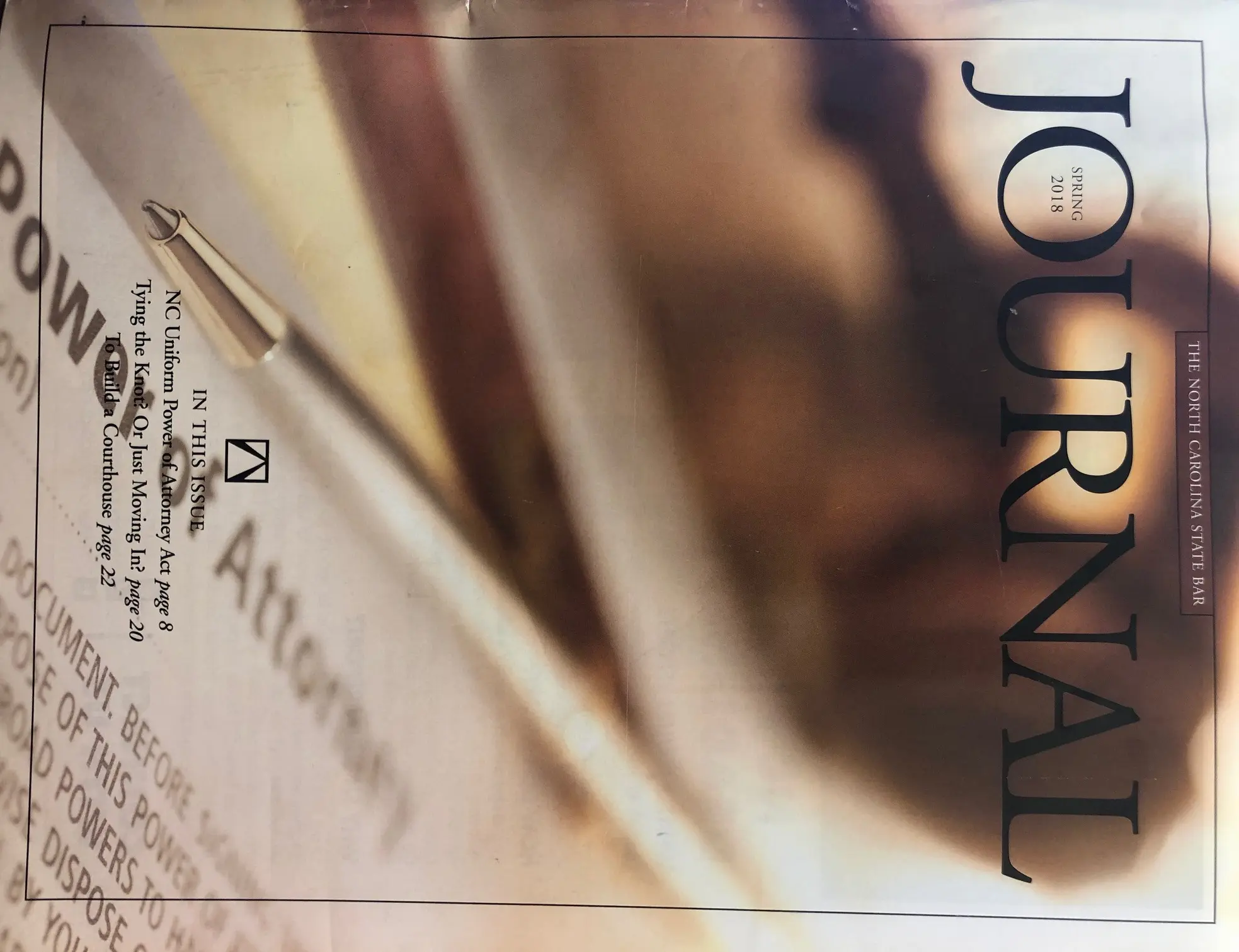
In his hurrah before retirement, Creekman authored “The North Carolina Uniform Power of Attorney Act: Practical Introduction for Real Estate Practitioners.” That article was recently published in the spring edition of The North Carolina State Bar Journal.
From the article:
Can we all agree that dealing with a power of attorney in North Carolina has long been, at best, a frustrating experience? Well, help is on the way! On July 20, 2017, Governor Cooper signed Senate Bill 569, “An Act to Adopt the Uniform Power of Attorney Act in this State,” into law as Session Law 2017-153. It took effect January 1, 2018, and if you haven’t already done so, you need to read it if you practice real estate law or are called upon to consider powers of attorney!
At the 10,000 foot level, the new law repeals or amends many of the existing statutes dealing with powers of attorney and adopts the Uniform Power of Attorney Act as drafted by the National Conference of Commissioners on Uniform State Laws, albeit with a multitude of tweaks and modifications tailored specifically to our needs in North Carolina.
The effort to get the legislation introduced and passed was admirably undertaken by the Estate Planning and Fiduciary Law Section of the North Carolina Bar Association, which was very careful in its drafting efforts to invite comments, suggestions, and input from a wide variety of interested groups, including the North Carolina Bankers Association, clerks of court, registers of deeds, advocates for the elderly, the North Carolina Department of Justice, and other sections of the North Carolina Bar Association.
Just so we’re clear on terminology—for ease of reference in this Article:
As happens with many complex pieces of legislation, changes made to a bill during the legislative process can result in minor inconsistencies or incorrect cross-references in the bill as finally enacted. That happened here. As a result, minor technical corrections to the Act will likely be forthcoming, probably during next year’s legislative session.
No effort will be made here to provide a detailed analysis of the new law, delve into the rights, duties, and obligations of an agent named in a POA, or identify needed technical corrections. Instead, after a brief overview of the Act, this article focuses on some critical things that you as a real estate practitioner need to know about the Act and its interface with existing law.
As a practical matter, existing law provides little more than a template for a North Carolina short form POA, rigid rules regarding durable POAs and an agent’s authority to make gifts from the principal’s estate, and limited guidance for third parties dealing with an agent.
The Act covers much more territory. It is rationally organized, relatively straight-forward, and divided into four Articles:
You can read the entire article online here or download a copy here.


September 22, 2026
September 18, 2026
Stay In Touch