


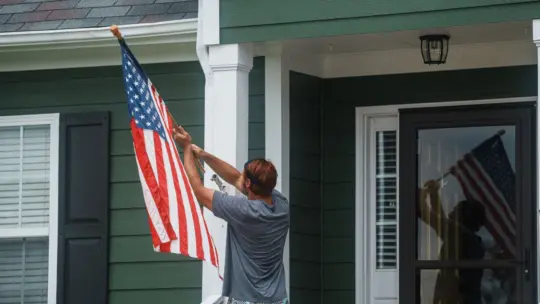
For two decades, North Carolina law has offered homeowners some protection when they want to fly the American or North Carolina flag at home.
That protection, however, came with an important exception: a community association (“HOA”) could still restrict or prohibit those flags if its governing documents contained the magic words. As of August 11, 2026, that exception is gone. Senate Bill 445, enacted as Session Law 2026-59, rewrote the flag provisions of both the North Carolina Condominium Act (G.S. 47C-3-121) and the North Carolina Planned Community Act (G.S. 47F-3-121). Here is what changed, what did not, and what owners, boards, and community managers should do next.
What the Law Said Before
Before the amendment, both statutes provided that, notwithstanding any provision in a declaration of covenants, no restriction on the use of land could be construed to regulate or prohibit the display of the United States or North Carolina flag, up to four feet by six feet, displayed in accordance with or in a manner consistent with the federal flag code customs in 4 U.S.C. §§ 5-10. The protection was then followed by the word “unless,” and two exceptions.
First, for restrictions registered before October 1, 2005, an association could regulate or prohibit these flags if the restriction specifically used one of four terms: “Flag of the United States of America,” “American flag,” “United States flag,” or “North Carolina flag.” Second, for restrictions registered on or after October 1, 2005, a restriction could regulate or prohibit the flags only if it appeared on the first page of the instrument, in boldface capital letters no smaller than the largest print used elsewhere in the document, and specifically stated: “THIS DOCUMENT REGULATES OR PROHIBITS THE DISPLAY OF THE FLAG OF THE UNITED STATES OF AMERICA OR STATE OF NORTH CAROLINA.”
In practice, this meant that some communities, particularly older ones whose declarations named the American flag, could lawfully regulate or ban flag displays, while others could not.
What Senate Bill 445 Changed
Section 4 of Senate Bill 445, titled “Further Prohibit Property Restrictions on Flying the American and North Carolina Flags,” deletes both exceptions in their entirety from G.S. 47C-3-121 and G.S. 47F-3-121. The word “unless” is struck, and the sentence now ends simply with a reference to the flag customs of the United States. The bill was ratified on August 6, 2026, approved by Governor Stein on August 11, 2026, and Section 4 took effect when it became law.
The result is straightforward: a restriction in a condominium or planned community declaration can no longer be construed to regulate or prohibit the display of a qualifying American or North Carolina flag on an owner’s property, regardless of when the restriction was recorded and regardless of how specifically or prominently it addresses the United States flag or North Carolina state flag. Language that once satisfied the pre-2005 “specific terms” test or the post-2005 boldface first-page disclosure no longer gives an HOA authority over these flags.
What Did Not Change
Several important limits remain in place, and boards and owners should read them carefully.
Size and manner. The protection still applies only to a United States or North Carolina flag no larger than four feet by six feet, displayed in accordance with or consistent with the patriotic customs in 4 U.S.C. §§ 5-10. An oversized flag, or one displayed in a manner inconsistent with the federal flag code, falls outside the statutory protection.
Owner’s exclusive property only. The protection continues to apply only to owners displaying the flag on property owned exclusively by them. It does not apply to common areas, easements, rights-of-way, or other areas owned by others. In a condominium, where building exteriors and grounds are often common elements, this distinction may significantly limit where a unit owner may display a flag, so the HOA’s governing documents should be reviewed closely.
Other flags. The statutes protect only the United States and North Carolina flags. Military service flags, sports flags, seasonal banners, and other flags remain subject to whatever restrictions an HOA’s governing documents lawfully impose.
Political signs. Senate Bill 445 did not amend the political sign provisions in subdivision (2) of each statute. Associations may still regulate or prohibit political signs if the governing documents meet the existing “political signs” terminology or first-page boldface requirements, and the 45-day/7-day election window and size-and-number rules continue to apply.
What “Consistent with the Flag Code” Looks Like at Home.
The federal flag code customs in 4 U.S.C. §§ 5-10 are mostly common sense, and a few examples show how they apply to a typical residence:
- Time of display. The flag is customarily flown from sunrise to sunset. An owner who wants to fly it around the clock should light it properly during darkness.
- Weather. The flag should not be flown in inclement weather unless it is an all-weather flag.
- Projecting staff. When the flag hangs from a staff projecting from a porch, window sill, or the front of the house, the union (the blue field of stars) belongs at the peak of the staff, unless the flag is at half-staff. These customs would also apply to displaying the flag on a freestanding flagpole.
- Flat against a wall or window. When the flag is hung flat against a wall or in a window, the union should be uppermost and to the flag’s own right, which is the observer’s left.
- Ground and condition. The flag should never touch the ground. It should never be flown upside down except as a signal of dire distress. It should not be used as drapery or bunting.
- Worn flags. A flag that is torn, faded, or otherwise no longer fit for display should be retired in a dignified way.
Owners who follow these customs and keep to the four-foot by six-foot size limit, would be considered to fall within the statute’s protection. Boards should remember that the statute protects a flag displayed “in accordance with or consistent with” these customs. That language suggests a minor or technical departure may not, by itself, take a display outside the protection. Enforcement based on flag code etiquette should be approached with care.
Practical Takeaways
Boards should review their declarations, rules and regulations, architectural guidelines, and design standards for any provisions restricting the American or North Carolina flag, and immediately stop enforcing them to the extent they conflict with the amended statutes. Remember, that even though the statute creates a narrow window to enforce oversized American and North Carolina flags, as well as American and North Carolina flags displayed in a manner that is inconsistent with the federal flag code, the ability to enforce such exceptions must be found in the HOA’s declaration. Accordingly, boards may wish to adopt or update rules that address matters still within the HOA’s control, such as displays on common elements or flags other than the U.S. and North Carolina flags.
Conclusion
Senate Bill 445 brings clarity and uniformity to flag displays in North Carolina’s HOA’s. The question is no longer what a community’s documents say about the American or North Carolina flag, but whether the flag meets the statute’s size, manner, and location requirements. If your HOA has questions about how the amendment affects its governing documents, enforcement practices, or pending disputes, the community association attorneys at Ward and Smith, P.A. are available to help.