



Navigating Wetlands in Coastal North Carolina Real Estate Development
April 25, 2025

Our attorneys have represented property owners, developers, municipalities, marina operators, and other businesses at every regulatory body that shapes what you can do with coastal land. That depth of experience means you get attorneys who know these regulators, these waters, and this land.
Coastal development in North Carolina touches a web of state and federal agencies. Our attorneys guide clients through every layer of it, including:
Our team also stays abreast of emerging national environmental law trends affecting the coast. Clients count on us for guidance with:
Coastal law rarely arrives alone. A development permit dispute involves environmental law, real estate, zoning, construction, and sometimes litigation. A marina acquisition involves real estate, financing, and environmental review.
Ward and Smith attorneys across those practice areas and across the state collaborate as a single team, so your coastal matter gets the full depth of a firm that has worked in every corner of North Carolina. Our Morehead City office places us at the heart of the Crystal Coast, and our Wilmington office serves the Cape Fear region. We service North Carolina’s Outer Banks and Inner Banks from our New Bern office.
Preserving over 300 miles of coastline while accommodating growth and development requires the legal finesse and regulatory knowledge to overcome these environmental law hurdles. Our multidisciplinary team can give clients comprehensive legal representation in multiple areas, including environmental law, construction, real estate and real estate development, government relations, and litigation. If you require professional legal advice and representation, we can help.
Our attorneys appear regularly before the NC Coastal Resources Commission, the NC Department of Environmental Quality (NCDEQ) Divisions of Coastal Management and Energy Mineral and Land Resources, and the US Army Corps of Engineers. We stay current on emerging national coastal law trends and regulatory shifts. When challenges arise, our litigation team is ready to defend permit decisions and protect your investment in state and federal court.
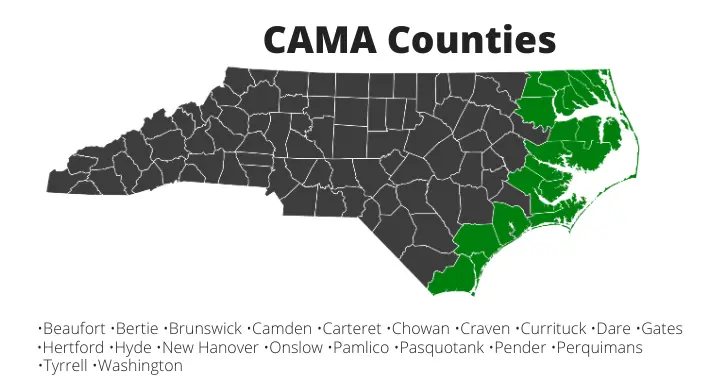
CAMA stands for the Coastal Area Management Act, which governs development in North Carolina’s 20 coastal counties. A CAMA permit is required for most development within an Area of Environmental Concern (AEC), which includes estuarine shorelines within 75 feet of the normal high water line, ocean hazard areas, coastal wetlands, and public trust waters. Three permit types exist: minor permits for smaller residential projects, major permits for larger or more complex projects, and general permits for routine activities. If your property is near the waterfront in a coastal county, your project might require a CAMA permit before work begins.
Yes. A denial or a permit issued with unreasonable conditions can be contested through an administrative appeal before the NC Office of Administrative Hearings. The process has strict deadlines, so acting quickly after receiving an unfavorable decision is critical. Ward and Smith attorneys appear regularly before OAH and can advise on the strength of your grounds for appeal and represent you through the process.
Minor permits cover most residential projects such as single-family homes and are issued by local permit officers with a decision typically within 25 days. Major permits are required for larger projects, projects needing other state or federal approvals, or those covering more than 20 acres or construction covering more than 60,000 square feet. Major permit applications are reviewed by up to 10 state and four federal agencies and take much longer. General permits cover routine activities with predictable, minor impacts, like docks and piers.
Often yes. Marina development, dredging, and dock construction in navigable waters typically requires both a CAMA major permit from the NCDEQ Division of Coastal Management and a Section 404/Section 10 permit from the US Army Corps of Engineers. These processes can run concurrently but involve different agencies with different standards. Ward and Smith has experience coordinating both permit processes and managing the interplay between state and federal requirements for marina and waterfront projects.
Proceeding without a required CAMA permit can result in stop-work orders, fines, and orders to restore the site to its past condition, which can be costly. The NC Division of Coastal Management actively enforces CAMA requirements. If you are facing a CAMA enforcement action, contact an attorney promptly to understand your options and limit your exposure.
North Carolina’s State Stormwater Program, administered by the NCDEQ Division of Energy, Mineral and Land Resources, requires a stormwater permit for most development that disturbs land or creates impervious surface in coastal and non-coastal counties alike. In the 20 CAMA counties and certain other sensitive watersheds, the rules are stricter: lower impervious surface limits, more stringent runoff controls, and in some cases built-upon area caps that cannot be exceeded no matter what your local zoning allows.
Projects near Outstanding Resource Waters (ORW) or High Quality Waters (HQW) face the most demanding requirements. A stormwater permit must typically be in hand before building permits can be issued, and failure to comply can result in enforcement actions, stop-work orders, and personal liability for developers and property owners.
Ward and Smith handles stormwater variance requests, third-party challenges to issued permits, and compliance counseling for both new development and expansions of existing projects.
Coastal property owners often encounter three overlapping layers of regulation: local zoning ordinances, CAMA rules administered by the NCDEQ Division of Coastal Management, and the State Stormwater Program. These three systems do not always align. A use permitted by local zoning may still require a CAMA permit and a Stormwater Permit.
A project that complies with CAMA setbacks may still exceed the impervious surface limits allowed under the state stormwater rules for that watershed. And local ordinances in some coastal communities impose setbacks, height limits, and density restrictions that go beyond what state law requires. Navigating all three systems simultaneously and understanding which constraint is the binding one for a project, is a common challenge Ward and Smith attorneys solve for coastal developers and property owners. Getting the sequencing of applications right, and identifying conflicts early, can save months of delay and significant cost.
North Carolina recognizes the public’s right to access and use the wet sand beach, the area between the mean high-water mark and the water’s edge, as a public trust resource. That right is grounded in both the public trust doctrine and North Carolina statutes.
However, the dry sand area above the mean high-water mark is typically private property, and landowners generally have the right to limit or restrict access across it, subject to any prescriptive easements or common use rights that may have evolved. The boundary between public and private beach is not always clear and can shift as shorelines erode or accrete.
Disputes over beach access, dock access, riparian rights, and the scope of public trust rights are increasingly common in North Carolina’s coastal communities. Ward and Smith represents both property owners protecting their private rights and municipalities and community groups asserting or defending public access rights.

February 26, 2024

December 28, 2022